The Range Rover Sport continues as part of the current generation introduced for the 2023 model year. It is built on the MLA-Flex platform, a mixed-material architecture designed to support internal combustion, mild hybrid, plug-in hybrid, and battery-electric powertrains across the Range Rover lineup.
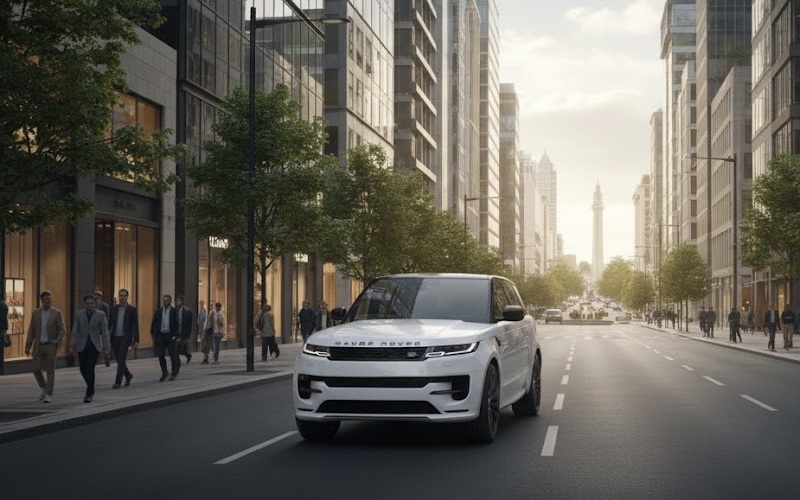
This platform forms the structural basis for the vehicle’s performance, ride quality, and handling systems. The Range Rover Sport is available with multiple powertrain configurations, advanced suspension technologies, and electronic control systems that influence steering, stability, and traction.
MLA-Flex Platform Structure
The MLA-Flex (Modular Longitudinal Architecture) platform uses a lightweight aluminum-intensive structure. It incorporates:
- High-strength aluminum body panels
- Mixed-material construction for rigidity
- Increased torsional stiffness compared with the previous generation
Higher structural stiffness supports:
- Improved suspension calibration
- Reduced body flex under load
- Greater stability during cornering
- More precise steering response
The platform also supports electrified systems, including mild- and plug-in-hybrid configurations.
Powertrain Options
The Range Rover Sport offers several engine configurations within the current generation.
Ingenium Inline-Six Engines
Available 3.0-litre turbocharged inline-six engines feature mild hybrid (MHEV) technology. These engines use an integrated starter-generator and a 48-volt electrical system.
Typical configurations include:
- P360: Approximately 265 kW
- P400: Approximately 294 kW
Both engines pair with an 8-speed automatic transmission and full-time all-wheel drive.
Plug-In Hybrid System
The plug-in hybrid version combines:
- A 3.0-litre inline-six engine
- An electric motor
- A lithium-ion battery pack
This system delivers a combined output of approximately 375 kW in recent specifications. It allows short-distance electric-only driving under certain conditions.
V8 Engine
A 4.4-litre twin-turbocharged V8 engine is available in higher-performance variants. Output figures in recent versions reach approximately 390 kW.
All engines connect to:
- An 8-speed automatic transmission
- A two-speed transfer case (on applicable variants)
- Permanent all-wheel drive
Eight-Speed Automatic Transmission
The Range Rover Sport uses a ZF 8-speed automatic transmission.
Key characteristics include:
- Wide gear ratio spread
- Electronic shift control
- Adaptive shift logic
The transmission interacts with drive modes and terrain settings to adjust shift timing and response. In manual mode, steering wheel-mounted shift paddles allow driver input.
All-Wheel Drive and Driveline Systems
Full-time all-wheel drive is standard across the lineup.
Intelligent Driveline Dynamics
The system distributes torque between the front and rear axles based on:
- Traction conditions
- Steering angle
- Throttle input
- Wheel speed data
An electronically controlled centre differential manages torque allocation.
Active Locking Rear Differential
On certain variants, an electronically controlled rear differential enhances traction by distributing torque between rear wheels. This improves stability during cornering and traction on uneven surfaces.
Suspension Architecture
Air Suspension System
Electronic air suspension is standard on most versions.
System characteristics include:
- Variable ride height
- Adaptive damping
- Automatic self-levelling
The system adjusts ride height for:
- Off-road clearance
- Highway efficiency
- Easier entry and exit
Dynamic Response Pro
Dynamic Response Pro is an active anti-roll control system available on higher trims. It uses a 48-volt electrical system to power the active roll-control motors at each axle.
System effects include:
- Reduced body roll during cornering
- Increased stability at higher speeds
- Independent control of front and rear roll stiffness
The system can decouple during off-road driving to allow greater wheel articulation.
Steering System
Electric Power-Assisted Steering
The Range Rover Sport uses electric power-assisted steering (EPAS).
Features include:
- Variable steering assistance
- Speed-sensitive adjustment
- Integration with driver assistance systems
The system reduces steering effort at low speeds and increases stability at highway speeds.
All-Wheel Steering
Available all-wheel steering enhances manoeuvrability and stability.
System functions:
- Rear wheels turn opposite the front wheels at low speeds
- Rear wheels turn in the same direction as the front wheels at higher speeds
This results in:
- Reduced turning circle
- Improved lane-change stability
- Increased control during high-speed cornering
Brake System
The braking system uses large ventilated disc brakes on all four wheels.
Key components may include:
- Multi-piston front callipers on performance variants
- Electronic brake-force distribution
- Anti-lock braking system (ABS)
- Emergency brake assist
Brake-based torque vectoring works with stability systems to control wheel slip and cornering dynamics.
Terrain Response 2 System
Terrain Response 2 adjusts vehicle systems according to surface conditions.
Selectable modes typically include:
- Auto
- Grass/Gravel/Snow
- Mud/Ruts
- Sand
- Rock Crawl
- Dynamic (on certain variants)
The system modifies:
- Throttle response
- Transmission shift mapping
- Differential settings
- Suspension height
- Traction control thresholds
In Auto mode, the vehicle selects appropriate settings based on sensor input.
Adaptive Dynamics
Adaptive Dynamics continuously monitors vehicle movement using sensors that measure:
- Wheel position
- Body motion
- Steering input
- Throttle position
Dampers adjust in milliseconds to balance comfort and control. The system aims to maintain stability during acceleration, braking, and cornering.
Stability and Control Systems
The Range Rover Sport integrates multiple electronic systems that influence handling.
Dynamic Stability Control (DSC)
DSC monitors:
- Yaw rate
- Steering angle
- Wheel speed
It applies selective braking and reduces engine torque when necessary to maintain stability.
Roll Stability Control
Roll Stability Control works with the suspension and braking systems to reduce the risk of rollover during sudden manoeuvres.
Hill Descent Control
Hill Descent Control maintains a controlled speed on steep descents without constant brake input from the driver.
Plug-In Hybrid Chassis Integration
In plug-in hybrid variants, the battery pack integrates into the vehicle floor structure.
Design considerations include:
- Low centre of gravity
- Weight distribution balance
- Reinforced underbody protection
Electric motor torque supports low-speed response and reduces lag during acceleration.
Aerodynamic Characteristics
The body design supports airflow management through:
- Smooth underbody panels
- Active grille shutters (on certain variants)
- Rear spoiler integration
These features reduce drag and support high-speed stability.
Towing and Load Capability
Depending on configuration, the Range Rover Sport offers a maximum towing capacity of up to approximately 3,500 kg when properly equipped.
Trailer Stability Assist works with stability control systems to detect and counteract trailer sway through selective braking and torque management.
Driver Mode Configuration
Selectable drive modes affect multiple systems simultaneously.
Dynamic mode, where available, adjusts:
- Throttle calibration
- Transmission behaviour
- Steering weight
- Suspension firmness
- Stability control thresholds
Comfort-oriented settings prioritize ride isolation and smoother response.
Structural Safety Integration
Performance architecture integrates with safety systems.
Key elements include:
- Rigid passenger cell
- Engineered crumple zones
- Integrated electronic control systems
These structural and electronic systems support controlled vehicle behaviour during emergency manoeuvres.
2026 Range Rover Sport Performance Architecture
The Range Rover Sport combines:
- Aluminum-intensive MLA-Flex structure
- Multiple powertrain options, including mild hybrid and plug-in hybrid systems
- 8-speed automatic transmission
- Full-time all-wheel drive
- Electronic air suspension
- Active roll control (Dynamic Response Pro)
- All-wheel steering (available)
- Terrain Response 2 system
- Adaptive damping and stability controls
These systems work together to balance on-road precision with off-road capability while maintaining structural rigidity and electronic integration.
Questions and Answers
What platform does the 2026 Range Rover Sport use?
- It uses the MLA-Flex modular longitudinal architecture with an aluminum-intensive structure.
What type of transmission is paired with the available engines?
- All engines connect to an 8-speed automatic transmission.
What is the maximum towing capacity when properly equipped?
- The maximum towing capacity reaches approximately 3,500 kg.
What system reduces body roll during cornering on higher trims?
- Dynamic Response Pro uses active anti-roll control to reduce body roll.
What does Terrain Response 2 adjust in the vehicle?
- It modifies throttle response, transmission mapping, differential settings, suspension height, and traction control thresholds.
Disclaimer: Content contained in this post is for informational purposes only and may include features and options from US or internacional models. Please contact the dealership for more information or to confirm vehicle, feature availability.